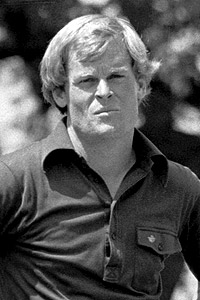
Add Bob Charles, David Graham, Johnny Miller, and Nick Price, to the list of major championship winners who play golf from the "opposite" side. That makes eight total that I've learned about. There must be more -- right?
Natural Righties Who Play Lefty
Bob Charles (1963 Open Championship)
Mike Weir (2003 Masters)
Phil Mickelson (2004, '06, '10 Masters; 2005 PGA Championship)
Natural Lefties Who Play Righty
Johnny Miller (1973 U.S. Open; 1976 Open Championship)
David Graham (1979 PGA Championship; 1981 U.S. Open)
Greg Norman (1986, '93 Open Championship)
Curtis Strange (1988, '89 U.S. Open)
Nick Price (1992, '94 PGA Championship; 1994 Open Championship)
So here's an interesting twist on the left- vs. right-hand debate. It seems there are a couple of organizations that cater to one-armed golfers. The "domestic" version is the North American One-Armed Golfer Association (NAOAGA); their European counterpart is the Society of One Armed Golfers. In addition to sponsoring various championships, the two organizations stage a biennial Ryder Cup-style competition called the Fightmaster Cup. Alas, much like their two-armed counterparts, the Europeans won the 2010 match, which was also held in Wales, by a score of 16-12.
Here's a video of the top American player, 47-year-old Bobby Baca, in action:
What I find interesting, in perusing photos on the NAOAGA website, is that while most of the golfers seem to swing the club in a "forehand" style, a number of them are "backhanders." I'd be very curious to learn more about the advantages and disadvantages of each approach, and why each golfer chose to swing the way he does.
What do you think? Would forehand or backhand be a better way to go? Personally, it certainly seems like it would be easier to go forehand – but I wonder what the advantages to backhand would be.
As far as I know, Ben Crane has never been one to make a lot of noise on tour – except for winning a couple tournaments while playing frustratingly slow. So I can't say if this is "out of character" for him – though it is surprising, and very funny ...
UPDATE: For a little more background on the video, click HERE.
Four-time major winner and perennial world #2 Phil “Lefty” Mickelson is right-handed. So is 2003 Masters champion Mike Weir. And so, for that matter, is tennis great Rafael Nadal. Yet each of these guys has succeeded wildly at their respective sports playing from the sinister side.
What’s up with that?
Ever since I was a kid first taking up the game of golf, I was taught that the left hand is, or should be, the dominant hand in a right-handed golf swing. “You’re using too much right hand!” was my dad’s most consistent piece of advice. “Let your left hand pull the club through; don’t push it through with your right.”
How can that be? I always wondered. I throw with my right hand. I write with my right hand. I hit my annoying younger brother with my right hand. Why wouldn’t I use my right hand more to swing a golf club?
And, assuming it’s true that I shouldn’t, wouldn’t it make sense for me, as a right-handed person, to play golf left-handed?
That thought has haunted me ever since. And so when Phil the Thrill, the right-handed lefty, first burst onto the scene by winning the U.S. Amateur and a boatload of college titles (not to mention a PGA victory) as a young amateur, I assumed he was a product of just such a theory. Surely, I thought, someone must have groomed him to play as a southpaw with an eye toward testing this theory – and hopes of turning him into a world-class player.
The truth, as it turns out, is more mundane – but at least as interesting. When Phil was first taking up the game as a wee lad in San Diego, California, he learned to swing a club by standing in front of his father and literally mirroring the elder Mickelson’s movements. At some point they tried to turn him around, to swing the club like a proper right-handed little boy. But Phil was a stubborn cuss, and he would have none of it. So a “lefty” he remained, albeit only on the golf course. But did it make him a better golfer?
Mike Weir, being from Canada, has a different story. Like most young boys in the Great White North, Weir’s first love was hockey. A natural right-hander, Weir found he could swing a hockey stick more easily with his left hand low. So that’s how he played. It probably didn’t hurt that in hockey it’s helpful to have left-handed shooters playing on the left side of the ice [hockey players, am I right in this?], putting left-handed players in greater demand.
When “Weirsy” took up golf later, it only made sense for him to swing from the “wrong” side of the ball – using a partial set of left-handed clubs handed down to him by a family friend. Good thing, too. If none had been available, he may have been forced to turn things around – and who knows where his golf may have led him then. To obscurity? Or to possibly even greater heights? The world will never know.
“Switch-hitting” the other way (lefties playing righty) is more common still. From what I've read, some 15 percent of the population at large is left-handed, only about 10 of golfers overall play that way. This is not likely due, however, to thinking they’ll have an advantage that way; it’s simply because there are a lot more right-handed clubs sitting around in basements and garages. Often, lefty boys and girls are forced to learn on whatever equipment they can find – which far more often than not is right-handed.
This may explain why natural lefties Greg Norman (world #1 for 331 weeks) and Curtis Strange (a back-to-back U.S. Open champion) play right-handed. (The plot thickens!)
So certain questions remain unanswered: What role, if any did “the big switch” play in the success of Mickelson and Weir? (Or Norman and Strange, on the other hand.) Would they, could they, have succeeded as righties? Given he success of these four great champions, is a golfer potentially better off learning to play from the opposite side?
What do YOU think? Is there a potential advantage to be had playing from the opposite side? And if so, would it have to be learned from the start – or could an old dog potentially learn this new trick?
Sound off in the comments section!
UPDATE: Friend of Whiffling Straits the Armchair Golf Blog has published a version of this post HERE.
I was not quite 10 years old in 1973 when Secretariat captivated the country's imagination. I had no idea, of course, of the historical significance I was witnessing, but how could a not-quite-10-year-old boy who loved sports and animals not be thrilled by seeing a horse win the biggest race of his life by 31 lengths? Secretariat's Triple Crown triumph that year – his amazing Belmont Stakes victory in particular – was one of the most dominating performances in sports history. He remains one of my great sports heroes.
What could compare -- maybe a 24-year-old golfer winning the U.S. Open by 15 at Pebble Beach?
By the way, in case you're wondering, the opening lines in the trailer posted above are derived from chapter 39 of the Book of Job, verses 19-25 (I'm just sayin'):
Do you give the horse his strength
or clothe his neck with a flowing mane?
Do you make him leap like a locust,
striking terror with his proud snorting?
He paws fiercely, rejoicing in his strength,
and charges into the fray.
He laughs at fear, afraid of nothing;
he does not shy away from the sword.
The quiver rattles against his side,
along with the flashing spear and lance.
In frenzied excitement he eats up the ground;
he cannot stand still when the trumpet sounds.
At the blast of the trumpet he snorts, 'Aha!'
He catches the scent of battle from afar,
the shout of commanders and the battle cry.
... why Steve Stricker is not getting more talk for Player of the Year. For instance, Cameron Moffit, Senior Writer at Golf magazine, writes this today over at golf.com:
A lot of people could make a case for POY with a victory, most notably Barclays winner and FedEx points leader Matt Kuchar; BMW winner Dustin Johnson, who is second in FedEx points; newly minted Hall of Famer Ernie Els and Jim Furyk, who have two Tour victories apiece this season but have been relatively quiet lately.
No mention of Stricker at all? Really? Yes, yes, I know I'm hopelessly biased. But it's easy to make the case on paper (or in pixels). I agree that if Kuchar or any of the above two-time winners emerges victorious at East Lake in the Tour Championship this weekend, they will likely lay claim to POY honors. But Stricker also has two twins. Granted, one was a second-tier event, the John Deere. But it still counts. And even if you wanted to only call it a "half-victory," adding the Tour Championship would put him at 2.5 wins, best on Tour.
Much of the talk surrounding Kuchar involves his consistency, as evidenced by all his top-10 finishes. He has 11 in 24 events to lead that category. But Stricker is close behind with 9 – in just 18 events. So Stricker's top-10 "average" is actually a little better: 50% to 45.8% (Stricker played fewer events this year due to a shoulder injury).
Yes, Kuchar leads the money list, with $4,753,727 to Stricker's $4,062,735 (#4). But again, with 24 events to Stricker's 18. Stricker leads in average money per event with $225,707.50 to Kuchar's $198,071.89. Again, which looks more "consistent" to you? And if Stricker wins (again, my case is all premised on him winning this week) he would certainly jump to #2, and could possibly even pass Kuchar (I think) if he stumbles badly.
Finally, Kuchar and Stricker are in a virtual dead heat for the Vardon Trophy, which goes to the lowest (adjusted) stroke average. Kuchar sits narrowly on top with a 69.57 average; Stricker is within a grass clipping at 69.58. Whoever beats the other this weekend will almost certainly take the lead in this category.
(Dustin Johnson probably has the most compelling case after these two, given his two victories, current #2 position on the money list, and two memorable performances in majors. He'd get my vote if Kuchar doesn't win this weekend and no one gets to three victories. And Kuchar I think has a wonderful case for Comeback Player of the Year. In 2007 he finished 115th on the money list. In 2008, 70th. In 2009, 24th. And this year, he currently sits at #1. That's quite a remarkable improvement – perhaps a little too gradual to capture the attention of voters, but I feel it's deserving, nonetheless.)
There you have it: an iron-clad case for Stricker as the 2010 PGA Tour Player of the Year – IF he wins this week. So why does no one seem to be talking about him in that context? I just don't know. Maybe it's just that no one wants to see him fill the FedEx cup with tears of joy.
A few hurried, back-handed stabs at items that have caught my attention in the golfing world ...
The Best Swing on Tour. Over at golf.com, Golf magazine's panel of "Top 100 Teachers" have come up with a list of seven of the "best" golf swings on tour, based on different individual components. Who did they decide has the "Best Overall Swing"? You'll never guess. Oh, wait ... you probably already have.
Nicklaus and Woods have been compared every which way, from driver through putter and beyond, with the sum total long considered almost a wash. But the potential for major life mistakes that seemed moot in two people so driven and organized has suddenly become the most important element of all. Nicklaus' steady conservatism, which on the course might have begun to seem quaint and even limiting in contrast to Woods' bolder style, has become the potential off-the-course difference-maker. As Nicklaus sits in the clubhouse, an early finisher watching the recklessness that has cost Woods the lead, the score Jack posted is looking better.
The Ryder Cup Runneth Over ... with Christians, it seems. A few people have noticed that three of the four captain's picks by Corey Pavin, a born-again Christian, are regulars at the Tour's weekly Bible study – as are a few who earned their way on (not to mention some of Pavin's assistant captains). Is there a holy conspiracy afoot? Probably not, posits Wall Street Journal writer John Paul Newport in his weekly Golf Journal column.
Title Defense – Failed! Last weekend the Whiffler attempted to defend his title at the annual White Lake Classic in Michigan. No blood clots this year, but a lingering hamstring injury – the result of a freak soccer-coaching accident several weeks ago (it's for the CHILDREN!) – probably helped ... uh, hamstring my efforts to repeat. To prepare (since I hadn't swung a club since the accident), I'd been repeatedly visualizing the 6-iron I hit a few years back to get just inside Steve Stricker's shot at the "beat the pro" par-3 hole at a charity golf outing. (What? I never mentioned that before? Huh. For one brief, shining moment, I bettered the best swing on Tour!)
Alas, all that visualizing wasn't enough – though I did hit one of the best six-irons of my life, to about five feet, for a birdie on the 18th hole of the warm-up round. The shot helped cap an amazing back-nine comeback by Team Butt Hutt to secure a free dinner that night. Victory never tasted so succulent as the ribeye steak I gorged on by Lake Michigan.
But congratulations to Mike "Scruffy" "Landfill" "Homer" "Skipper" Neuses (below, with arms crossed) for his impressive victory in the main event the next day.
UPDATE: In response to Chery's comment below, here are Scruffy/Serbo, Zim (the Whiffler), the Glacier, Keith, and Little Tommy.
Going into Monday's final round at the Deutsche Bank Championship, defending champ Steve Stricker has gone 72 holes without posting a bogey or worse on his scorecard. This includes 54 holes at the Deutsche Bank and the final round of the Barclay's. The last person to win a PGA tournament without a bogey was Lee Trevino at the 1974 Greater New Orleans Open. (Image: Getty Images via telegraph.co.uk)
Funny thing is, Steve Stricker isn't leading: he's four strokes off the pace in a tie for fourth, behind leader Jason Day at -17.
It's tempting to say that Stricker's style of play is too conservative, that's he's not making bogeys, but not making enough birdies, either. But Stricker has shown many times that he's more than capable of going low, especially on a soft course such as the players are seeing at the Deutsche. This is the man who shot 60 at the John Deere this year (to Paul Goydos's 59), and holds the PGA Tour scoring record for 72 holes, at -33 in the 2009 Bob Hope Classic. (Unfortunately for Steve, the Bob Hope is a five-round tournament, and he lost his lead that year in the final round, but the record is still official.)
Don't be surprised if Steve starts making more putts today and puts some pressure on the leaders. I'd love for Steve to win, of course. But as a fan of "quirky" statistics, I wouldn't be too disappointed if Steve continues is bogey-free streak today but comes up a stroke or two short of victory. Then you could add a "bogey-free runner-up" status to his back-to-back Comeback Player of the Year awards.
UPDATE: Well, there's your jinx. Less than an hour after I posted this, Stricker bogeyed the first hole of the final round – from 124 yards out in the fairway, no less. Hopefully, if he was thinking about it, he's not anymore!
At Sunday's final round of the Wyndham Resorts Championship, India's Arjun Atwal (a Monday qualifier!) faced a difficult approach to 18 while holding a one-stroke lead. He had a slightly downhill lie in the left rough, some 189 yards from the pin. What's the right play? At golf.com, Mitchell Spearman, a "Golf Magazine Top 100 Instructor," describes Atwal's thought process and subsequent shot selection:
A 5-iron was plenty of club to reach the flag, but Arjun knew that if he mishit the shot even a little, the ball would likely wobble into one of the gaping front greenside bunkers and he'd have a 30-yard sand shot. Instead, Arjun hit his rescue club, knowing the ball would fly past the green and settle near a grandstand surrounding the green on all sides. Arjun knew that no matter where the ball landed, he'd almost surely get a free drop by the green, and that would leave him a chance to make a simple chip and putt for par and the victory.
Atwal then did "exactly that," made par and won the tournament. Spearman called it "one of the savviest and best decisions of the year by any player." (Image: Atwal hits his approach at 18. Hunter Martin/Getty Images, via golf.com.)
I say, "great!" Congratulations to Atwal on some savvy course management and stellar play. But I couldn't help but be reminded of a similar situation faced by one Jean Van de Valde 11 years ago at the British Open.
You probably know the story; it's one of the most famous "bone-headed" plays in golf history. Standing on the 18th tee at Carnoustie on Sunday with a 3-stroke lead, Van de Velde pulled a driver – a club he'd been hitting fabulously all week – at the long par-4 and hit it way right. Fortunately for him, the ball was so far off-line he ended up with a good lie in the next fairway – but was still a long way from the green. What's the right play?
(A thought on the driver selection: A lot of commentators lambasted Van de Velde, especially in hindsight, for not hitting something "safer" off the tee. But in a pressure situation like that, a strong argument can be made for sticking with what's been working (dance with the girl who brung you, you might say). If he had pulled a fairway wood or long iron, and sprayed it into the burn, he probably would have been criticized for that!)
People seem willing to "forgive" him hitting the driver, but the second shot is where most consider the bone-headedness to have begun in earnest. Rather than take a short or mid-iron and lay up in the fairway short of the green – for a wedge, two putts, and victory – Van de Velde pulled a two-iron and went for it.
Stupid, people said and still say. But I'm not so sure. What gets overlooked is that Van de Velde was in a very similar situation to Atwal – with two extra strokes to spare. Van de Velde felt confident he would get the ball to the green. And he knew (this is key) that if he sprayed the ball left or right, it would go in the grandstands and he would get a free drop near the green. Chip, two (or even three) putts, and victory.
Sure enough, the ball flew far and to the right, into the grandstands. That's when Van de Velde got perhaps the worst break in major championship history. Instead of hitting a fan or a seat and settling down safely among the people, the ball hit a round railing absolutely square (can you hit a round railing "squarely?") and took a huge bounce straight backwards. The ball flew so far back it hit the rocks lining the burn in front of the green, and took another big bounce, over the burn into the rough. (The way things played out from there, he would, in fact, have been better off if it had actually gone in the water at that point.)
This is where Van de Valde played the one shot he says he regrets. Rather than chip out sideways into the fairway, our French hero went for the green again, and chunked it into the burn from the gnarly rough. After wading into the water and briefly considering playing the ball from there (it was only half submerged at the time), he instead took a drop, hit his fifth shot into a greenside bunker, blasted out, and sunk a seven-footer for a triple-bogey 7 to sneak into a playoff – which he lost handily. (Image: Van de Velde wades into the Barry Burn – and poses for pictures!? David Cannon/Getty Images, via pga.com)
My point is simply that I think Van de Velde gets too harshly criticized. His first two shots are completely defensible. In fact, I'd go so far as to say his 2-iron second shot was a smart play, just as Atwal's was.
Needless to say I'm in a small minority with this opinion, but I take great comfort in discovering that noted Sports Illustrated golf writer Michael Bamberger is on the same page. In his book "This Golfing Life" (primarily a collection of magazine articles), he writes:
[Jim] Nantz asks Van de Velde if he had seen Tin Cup, the movie in which Kevin Costner plays Roy McAvoy, a journeyman pro who dunks one ball after another in the water on the last hole of the U.S. Open, blowing his chance for victory by prizing pride over prudence. Van de Velde had seen it. ... He said you could not compare Roy McAvoy to him. "He went for the dream, the perfect shot," Van de Velde said. "I was just playing my game." I understood completely what he was saying. I know nobody who agrees with this, except for Van de Velde, but he did not misplay a single shot en route to his seven on the last hole of the British Open at Carnoustie, not mentally. When things go wrong mechanically, what can you do? But if a person is trying his best, there's not much to criticize, although Lord knows people make a nice living doing so anyhow.
Later, Bamberger describes Van de Velde's 18th-hole decision-making this way:
Van de Velde hit a driver off the tee because, as he told me, "I always hit a driver, whenever I can." Many have been critical of that decision. They don't recall that when Tom Kite came to the final hole of the 1992 U.S. Open at Pebble Beach with a two-shot lead, he hit a downwind driver, despite the ocean that lines the left side of the hole and the out-of-bounds on the right. He won with a par.
There was nothing wrong with the tee shot, even though Van de Velde pushed it wildly to the right. It carried the burn and finished in the rough, where he drew a perfect lie. The golfing gods had been smiling on him all week, and they continued to. For his second shot, he had 189 yards to clear the burn in front of the green. "I am a professional golfer. I miss my two-iron, it still goes 200 yards." Easily. He pulled his two-iron from the bag and pushed the shot. He carried the burn, easily. The ball was sailing into the grandstand. No big deal, he thought, that's a free drop.
And that's when the golf gods stopped smiling on him.
I agree, Michael! And something tells me that perhaps Arjun Atwal would, as well.
Someone (perhaps [Padraig] Harrington) will blow a final-round chance to win the PGA Championship by posting a big number on the brutal 18th at Whistling Straits.
I certainly didn't predict that it would be because he grounded his club in a bunker that he didn't think was a bunker to incur a two-stroke penalty to miss a three-way playoff after missing a seven-foot putt that he thought at the time was to win the championship! Unbelievable. (As far as Harrington is concerned, I was a little bit right: He posted a double-bogey 6 in the second round to miss the cut by a stroke.)
After reflecting on the tournament for a few days, the one overriding reaction I have is a certain sadness that Whistling Straits is getting beat up because of what happened. Alan Shipnuk, for instance, wrote the following in his "Hot List" at golf.com (Whistling Straits was #4 in the "Not" column):
All the flaws of this monument to artifice and excess were revealed on Sunday. If the best players in the world can't birdie a hole, then it can't be very good. The bevy of contenders combined to make exactly one birdie on 17 and 18, the latter of which might be the worst finishing hole in golf. And it's fitting the tournament was tainted by the contrived faux-bunkers which serve no purpose other than to look good on TV. On the to-do list before '15: 1) blow up 18 and start over, 2) fill in, oh, 400 or so useless bunkers, 3) create some safe, smooth walkways for fans, as dozens were injured on the extreme terrain.
A couple of things ... are the blossoming fruit trees at Augusta National "useless"? I know it's not exactly the same thing. But many, many of those trees never come into play and are certainly there only for "cosmetic" reasons. In fact, they are essential to the aesthetic of The Masters. Same with the bunkers at Whistling Straits. The course wouldn't be the same without them. It wouldn't play any different if you filled in 400 of them, but the course would lose much of it's "wow" factor. And what's wrong with wanting the course to look good on TV? Not to mention give on-site spectators something to be amazed by.
I would agree that the 18th needs a little more tweaking. But I have mixed feelings about making it more walkable for spectators. Some improved pathways might be a good idea, but I wouldn't want them to come at the expense of "extreme terrain," which again is a big part of the course's essence.
As far as being a monument to "artifice and excess," let's focus on the excess, and again make a comparison with Augusta. Other criticism I've read is that Herb Kohler, the course's owner and primary visionary, is an ego maniac who just wanted to have a visually spectacular course unlike any other in the world with more bunkers than you could imagine. I say, "so what?"
The complaint is that Whistling Straits was absurdly expensively to build and is absurdly expensive to play and maintain. If he wants to spend the money to build it, and people want to spend $350 or so to play it, I say more power to 'em. The course is truly one-of-a-kind, the kind of experience you go home and tell your friends about. Should every golf course take this approach? Of course not. But this course is a wonder, completely surreal. Not the kind of course you'd want to play on a regular basis, but the kind of course you put on your bucket list.
I have no idea how the course does financially. For all I know it may be bleeding Herb Kohler dry. But if that's what he wants to do with his fortune, that's his choice.
"Hazards" vs. "waste bunkers." I was there on Friday and spent an amazing day with the Golden Bear Cub, 8, along with reader RobT and his son "Big Nate," who recently turned 9. When we decided to take the boys, I resigned myself to the idea that we might spend only a few hours there before the boys got sick of it, but I am still astonished that we there for a full 10 hours – almost the entire time that golf was being played that day, thanks to the fog delay in the morning. And the only complaints we got all day were that we didn't get to see Tiger Woods (who didn't tee off until 5:45 p.m. and only played six holes) and, even more catostrophic, that by the time we walked back to the car the little parking lot shuttle carts had shut down for the day. ("But Dad, you PROMISED, that we'd get to take a shuttle back to the car!!!!!!" "No, son, I said we'd take one if we could.")
But I digress. The big reason we were able to keep the boys engaged so long is that the extreme terrain, including the useless bunkers, provided a welcome diversion when they grew bored at times with the golf. They climbed hills, jumped in and out of sand traps, had races, and, on one occasion, chased one another with "sand bombs" (OK, it was my son chasing Big Nate, an activity I quickly put a stop to). Providing entertainment for the kids was certainly not Pete Dye's intention with the course design, but the extreme terrain certainly added to the richness of our experience that day. It was a heck of a lot of fun.
And as we traversed the course and watched the kids cavort, we noticed all the out of play bunkers and wondered if they would be considered "waster bunkers." We came to the conclusion that yes, they probably were. Because some of them had grass and weeds growing in them, and many of them were trampled nearly beyond recognition. Some were in such odd spots that we speculated that certainly no one would ever hit into them! ("I don't know, I'll bet Keith could find this one," Rob speculated. (Sorry, Keith. Rob said it, not me.))
But as the world now knows, every bit of sand on Whistling Straits was to be considered a "hazard," and played according to the rules so governing it. A local rules accommodation was made, however, for removing loose stones from the bunkers. I nodded when I read this later, as I had noticed that some of the sand in the bunkers looked a little rocky. All the more natural, I suppose.
Which leads us now to "the big question." That is, was Johnson done an injustice? After much consideration, I have to say "no," unequivocably. Here's why ...
The biggest thing for me is simply that the players were informed beforehand, in the clearest possible terms, that all the bunkers would be played as hazards, no matter their condition. Johnson admitted that he didn't read the rules sheet – though he also said he was aware of the rule, but simply didn't recognize his lie as having been in a bunker. He thought it was just a bare spot worn down by the crowd. So the question then becomes, should he have recognized it as a bunker?
The biggest outrage seems to be coming from players and others who think it's ridiculous that the crowd would be allowed to stand in a bunker. How could he know it's a bunker when all those people are there? And there were no rakes, why would he think it might be a bunker? Again, the whole bunker situation should have been top of mind for the players. Much of the talk about the course all week was about the sheer number of them. The fact that it never occurred to Johnson that he might be in one smacks of mental laziness. Can you imagine Tiger or Jack ever making such a mistake?
The whole point of major championships is that it's supposed to be a mental challenge as well as a physical one – perhaps even more so. Many golfers have the game to win a major, but far fewer have the mental fortitude to actually do it. As Nicklaus once said, he always thought he had a better chance to win majors than regular tournaments because at least half the field is essentially eliminated before they even tee it up.
Then there's the argument that the walking rules official should have alerted Johnson that he was, in fact, in a bunker. Frankly, I don't like this argument at all. Before this all happened, it never would have occurred to me that a rules official would ever proactively remind a player about a rule. In fact, it seems to me that this ought to be forbidden. According to the rules of golf as I understand them, only a caddy may assist a player in any way during the course of play. No coaching is allowed, and players aren't even allowed to ask or tell each other what club they hit on a given shot. Why would a rules official be allowed to assist a player in such a way? The rules of golf being as complex as they are, I'm all for having an official on-hand to clarify and interpret the rules, but only at the player's request.
If rules officials are allowed, or even expected, to remind players of rules in certain situations, where does it begin and end? It brings a lot of outside judgment into play, and could certainly create a situation where differing styles and tendencies among rules officials could potentially give one player an advantage over another.
Over at Free Drop, a blog by USGA rules official John Vander Borght, in a post titled "Should [PGA official] David Price have said something?", John writes that "Decision 34-2/3 tells us that a referee has no obligation to warn a player and prevent a breach, but there is no problem with him doing so as long as he does it for all players." Again, this just reinforces what I think. If one referee does it for "all players," and another chooses not to do it for any, that creates a potentially uneven playing field.
There's also the argument that the marshals did a lousy job getting the crowd out of the way, and that if they had cleared a wider space Johnson might have been able to recognize it as a bunker. Again, I say, "so what?" I will grant that it looks like the crowd control could have been better, but this is just one of the "hazards" of playing the 72nd hole in a major tournament.
Also lost in this discussion is that Johnson got a tremendous break with his lie. If he had found himself in a deep footprint in the bunker and not allowed relief, I would likely be a little more sympathetic. According to the TV announcers, Johnson hit his drive some 40 yards to the right of where he was aiming. He was way outside the limits of where he could have been expected to have a reasonable lie. If it weren't for the crowds, he might have been in knee-deep fescue. Or if he had hit into a "properly maintained" bunker, he might have found himself plugged behind a deep lip. Fact is, he got a huge break, a lie he didn't really "deserve," and failed to take advantage by committing a huge mental blunder.
It's also interesting to note that announcer Jim Nantz recognized Johnson as being in a bunker and identified it as such on the air (hat tip: Free Drop):
And if you watch the video above, and look where Johnson's ball is, it's hard to imagine that it didn't even occur to him that he might be in a bunker. Again, a mental error of monumental proportions.
I mentioned Nicklaus above, in the context of it being hard to imagine him ever making such a mental blunder. But the fact is that a young Nicklaus did once screw up in a major, in a way that may have ultimately cost him a chance at the title. In the famous 1960 U.S. Open at Cherry Hills, Nicklaus, then a 20-year-old amateur, was paired with the legandary and intimidating Ben Hogan for the final two rounds. Late in the final round, Nicklaus found a ball mark between his ball and the cup on a short putt. He wasn't sure if he was allowed to fix it (he was) and was too afraid, in Hogan's presence, to ask him or anyone else if he was allowed. He missed the putt, and it rattled him enough that he fell apart a little bit after that.
Johnson is young, just 26 – which is very young to have contended so seriously in two majors in the same year. Everyone marveled how he bounced back from his final-round collapse at Pebble Beach in June. And Johnson himself says he's already moved on from his crushing loss at Whistling Straits. And that's great. A demeanor like his can be a great help in playing great golf. But you also have to wonder if his laid-back style – some would call it "lack of intensity" – will hinder him in clutch situations.
The greats of the game are at their mentally sharpest in clutch moments. So far, Johnson has not demonstrated this trait. He'll need to if wants to make the leap from being a highly-talented young player who's won a few times to one of the elite players in the game.
He has the talent. Only time will tell whether his major experiences this year will make him or break him.
UPDATE: Regarding crzsabas's comment below, please enjoy this word from the e-Trade Baby (a.k.a. "Nigel"?) himself: