Over the weekend, Sir Bob Charles, the first left-handed golfer to ever win a major professional championship, the 1963 Open Championship, became the first person inducted into the New Zealand Golf Hall of Fame. The new hall of fame was inaugurated in honor of the 100th anniversary of New Zealand Golf.
We here at Whiffling Straits are intrigued by Sir Bob – and not just because he won the first major championship contended in my lifetime. It's also because he's not really a "left-hander." He's a natural righty who plays golf, as he prefers to call it, "backhanded," standing on the right side of the ball and hitting to his right. Recently, we had the honor of speaking to Sir Bob in his native New Zealand – about his backhanded approach to golf and his big win in July 1963.
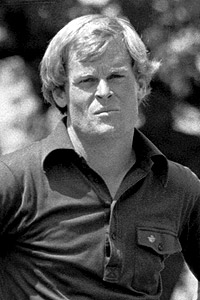
(Image: Condon/Getty Images, via pgatour.com)
Whiffling Straits: How did you come to be a right-handed person who plays golf left-handed?
Bob Charles: Well, I’m just doing something that comes naturally. It’s instinctive for me to grip with one hand, to pick things up, grip anything with my right hand. But when it comes to putting two hands on anything, I automatically put the left hand below the right hand. For example, if I pick up a rifle, I put the left hand belowthe right hand. If I pick up a pool cue, I put the left hand below the right hand. A spade, an axe, everything I do with two hands, I put the left below the right. And swing obviously … with an axe I swing it over my left shoulder, a rake … you know, that’s just natural.
WS: I had read in Sports Illustrated that your parents were both golfers and lefties, and that’s how you came across your first set of left-handed clubs, is that correct?
BC: Well, yes, that’s correct. Actually my mother started out as a right-handed golfer and she switched to becoming a left-handed golfer. My father is the same as me. He’s right-handed with one hand, but with two hands he puts the left hand below the right.
WS: Was it because of them that you started playing left-handed?
BC: Why did I start playing golf standing on the right side of the ball? It felt the most natural way to me. I play all ball games. I’m fascinated with all ball games. I’ve got my own tennis court here on the farm, I’ve got my own pool table in the house, I have a ping pong table, so … my father was a very good sportsman, and had a good eye, instinct for ball games. He was just playing what was natural for him. He played cricket, he was a good cricketer. He bowled right-handed, batted left. If you use baseball as an example, he and I both would have been right-handed pitchers and left-handed batters.
WS: Do you think there’s an advantage for a right-handed person to turn things around and play left-handed golf?
BC: I think a lot depends on whether you’re left-eyed or right-eyed. You see, I don’t consider myself a left-handed golfer. I’m a back-hander. I prefer to use backhand, I play a double-handed backhand. I stand on the right side of the ball, I hit the ball on the right side of the clubface and I’m hitting to my right. Now when I’m lining up a putt, I’m looking at the hole and the ball with my strong right eye. So, I’ve got a feeling … well, it’s not a feeling. I’ve got a theory I suppose is the best way of describing it. If you’re left-eyed you should be a right-handed putter, if you’re right-eyed you should be a left-handed putter. I think you get a better perception, better depth perception. If I’m looking to my right, to my strong side, visually I get a better picture looking right than looking left.
WS: What do you remember most about that (British Open) victory?
BC:There’s a lot of things. Let’s put it in context, we’re going back how many years? Well, 47 years, aren’t we? Of course, the field: the best players of the day were there. Nicklaus was there, Palmer was there, Player was there, Peter Thompson was there, Kei Nagle. They were the leading players of the day. I had won at Houston just the month before, so I arrived there full of confidence, having won my first tour event in the United States. So in effect, those five players I mentioned were probably the only ones I had to beat.
Nowadays of course things are quite different. What I’m saying is, the quality was there but there was no great depth to the field. Whereas today, instead of just five players, you’ve got 50 players to beat. So, as a fact, [I arrived] full of confidence, I had a great week. Putted particularly well. And of course the 36-hole final [playoff] with Phil Rogers was a little bit of an endurance contest, as you can imagine, playing 72 holes in two days. And I think I was the fitter of the two. Then, Phil Rogers would never consider himself to be one of the fittest people in the world. And my putting continued through the final and I think I won by, what was it, seven shots.
Monday, November 29, 2010
Friday, November 19, 2010
The Year in Pictures
How cool is this photo?
As someone who loves photography, I really enjoyed browsing the "2010 TOUR Photos of the Year" galleries at pgatour.com. The editors asked their three staff photographers to each pick their favorite 10 photos from the 2010 season. The photo above of Arnie, Jack, and Gary is by Chris Condon, taken at the Big 3 fund-raiser for the Mountain Mission Kids at the Olde Farm Golf Club on June 8.
"These guys don't get together very often and it was a pleasure to be a part of this event that raised a record amount of money for charity," Condon comments.
You can view the rest of the pictures, along with comments from the photographers, from all three galleries (including those of photographers Stan Badz and Caryn Levy) here.
Monday, November 8, 2010
Mike Small is Big Time
Steve Stricker says his former teammate Mike Small is doing an "unbelievable" job as coach of the Fighting Illini men's golf team. If Steve says it, it must be so – and the stats back him up. Small's Illini, the two-time defending Big Ten Champs, finished the fall season ranked 9th in the country in the Golf World/Nike Coaches Poll and claim the reigning NCAA men's individual champion and Big Ten Player of the Year, Scott Langley, among their ranks. In 2010, Small was named Big Ten Coach of the Year for the third time (2002, 2009).
On the course, Small is two-time defending champ at the PGA Professional National Championship – he's won the tournament a record-tying three times overall. He's also won a remarkable nine titles at the Illinois PGA, including the last eight straight.
That's why the staff here at Whiffling Straits was so honored to have spoken recently with Small about playing, coaching, and what the future holds, both for him and for his exciting Fighting Illini team.
UPDATE: Coach Small made the cut on the number this week at the Children's Miracle Network Classic at Disney World, the final official event of the 2010 PGA Tour season. He shot a 2-under 70 on Thursday and followed that up with a bogey-free 71 on Friday. He held fairly steady on the weekend, shooting 71-74 to finish at 2-under for the week in a tie for 65th place. Nice job, Coach!
(Image: Small with his 2010 PGA Professional National Championship Trophy. Montana Pritchard/The PGA of America.)
Whiffling Straits: Is it unusual for a college coach to play as much competitive golf as you do?
Mike Small: I don’t think anybody does it to my level. A lot of [college coaches] played in the past, on tour, but they seem not to have success once they start coaching. When I started coaching, I didn’t think I’d be playing this well or this much. So I didn’t really plan on it. But the way I’ve played, it just kind of evolved.
WS: What kind of challenges does that present?
MS: It actually presents a lot of them. It makes things really confusing. But I think there are a lot of positives that come out of it that outweigh the negatives. The negatives are, obviously, family time, away from home, I’m gone a lot. Coaching is my number one gig, my full-time thing, that’s what everything kind of revolves around. But at the same time, playing at my level, or trying to play, is an advantage to our program. It’s a niche that we have that kind of helps separate ourselves from other schools. I tell people we don’t have the ocean, we don’t have the [warm] weather, that a lot of other programs have … but every program has to kind of have a niche, a fit. And we run our program, approach our program from a player’s perspective, somebody who’s still playing. [Because] all these kids aspire to play on tour someday.
The positives behind it: being out there and still being in the game, competitively, learning the new stuff that’s on the cutting edge in golf when you’re on the PGA tour, playing in events, equipment-wise. I’m bringing information and knowledge back to the players that most coaches get second-hand. So to get that first-hand is always nice and it helps our development.
I always do my schedule around my coaching, but I have a very understanding AD – and my players are very understanding; they get a kick out of it. So when conflicts do arise, I have to make the decision based on what’s happening. But if we’re playing in a tournament that’s not as big or as prominent, or I can be gone when I need to play in a tour event, I usually can go. But that doesn’t happen very often at all. I try to have coaching be number one and playing be number two. And that’s the way I schedule my time professionally.
But with the family, and being gone a lot, it is tough. But they get a lot of advantages, too, being a coach at a major university, and also being able to play on tour. Like this next week we’re going to Disney World for the tournament. The whole family is going. So it will be fun to go down there and spend some time, kind of relive the old days of playing, and then our fall season is done. Where it gets tricky is with recruiting. Because coaches recruit every day, all day, almost. And I do that on the road, juggle two things at once.
But to wrap this whole answer up, personally I think it makes me better at both. Because if you do something all the time, 100% of the time, you get a little stale and burn out on it. I think coaching, if I’m coaching all the time with the guys, all spring, and I know I have some tour events coming up, or the PGA of America event coming up, in early summer, it kind of gives you something to look forward to and it gives you a fresh clear picture … you don’t get stale. There’s no repetitive stuff, there’s always something to look forward to, and vice versa. When I’m out playing for a week or two, I’m always looking forward to coming back and talking to the guys and see how they’re doing, and see what we can do with their game. I think my patience is better, I think I’m fresher at what I do with both of them. I’m not on edge or stressed out with just one job.
WS: Does it help you feel like one of the guys?
MS: Yeah, I think so. Normally I only play about four or five events a year. So I don’t really play a lot of tournaments, but I space them out so I stay involved. But it’s weird, the last 7, 8, 9 years, I’ve played so well in the PGA of America events, and the Illinois events, the Illinois Open, the Illinois PGA, I’ve been winning them. And it’s always in the news, and people are reading that and thinking I’m always playing. But I’m really not. I play four or five times a year.
Now this year I’ve played more. And next year I’ll play more. And like in 2006, I played more, because when I won the National Club Professional Championship – or the PGA Professional National Championship, what it’s called now, the PPNC – I get all those exemptions the following year. So I’ll play 11 or 12 events in those years, and this coming year, because of the exemptions. I’ve been fortunate to play well and get some media attention, so it seems like I’m playing a lot.
WS: Is it tough to keep your game sharp, to find time to practice?
MS: Yes. It’s getting harder and harder. I’m getting older. My kids are at an age now there are more things to do with them at night, school, and their activities. And yes, finding time to practice the last few years has gotten tougher.
WS: At this level of the college game, what do you primarily work on with your players?
MS: It’s probably more mental game, course management, scoring – scoring attitude and aptitude they have to have. But we’ll work individually on their golf swings if we need to. But if you’re a top 20 team in the country and you’re recruiting kids where you need to build golf swings, you’re recruiting the wrong ones. At this level … major college golf is not a golf academy. We need to teach these kids how to be players. And how to be tournament players and how to score and deliver a score. The golf swing is obviously a portion of that, but they should hopefully have good fundamentals when they come here.
What we spend a lot of time on is ball flight, distance control, short game, getting command of our short game, increasing the number of shots they have. Most of them have five or six different shot around the green when they come in, if that many. You need to have 20-25 to be good. We [work on] how to handle course conditions, the mental approach to the game, mental toughness, mental competence, how to handle different situations. And I think that’s where we tie it all together.
Monday, November 1, 2010
Happy Birthday, Gary!
Gary Player turns 75 today. Earlier this year, I predicted:
Gary Player, the Jack LaLanne Perry Como of professional golf, will celebrate his 75th birthday on November 1 with a 40th anniversary release of his album, "Gary Player Sings."
As far as I know, this is not going to happen. In the absence of a Gary Player serenade, however, here's a link to an interview at golf.com, which includes this enlightening snippet about Martin Kaymer:
"I like his manner, and the way he shaves every day."
Yes, Gary Player is unique, a man with his own way of thinking and of doing things. After I made the above prediction, I posted this reflection on "The Legend that is Gary Player." An excerpt:
That's two more majors than Arnie! Yet, who comes more readily to mind as one of the greatest players of all time? Probably Palmer over Player – a common perception that's really not supported by their respective records.I find Player absolutely fascinating. He has an inspiring backstory, having grown up dirt poor in South Africa, where his father was a miner. His mother died when he was 8. He's gotten where he is today by working harder than anybody in the history of the game (even Hogan, by my estimation), both on and off the course. The winner of nine (yes, nine!) major championships, he was an amazing player, even as he labored in the shadow of Palmer and Nicklaus. Because of the "golden era" in which he played, I think he sometimes doesn't get enough credit today for what he accomplished on the course. Who knows how many majors he would have won had he peaked in, say, the 1980s?
So happy birthday, Gary! May your stature one day grow as large in the minds of fans as it already is in your own!
Thursday, October 28, 2010
More Men in the Mirror
Add Bob Charles, David Graham, Johnny Miller, and Nick Price, to the list of major championship winners who play golf from the "opposite" side. That makes eight total that I've learned about. There must be more -- right?
Natural Righties Who Play Lefty
Bob Charles (1963 Open Championship)
Mike Weir (2003 Masters)
Phil Mickelson (2004, '06, '10 Masters; 2005 PGA Championship)
Natural Lefties Who Play Righty
Johnny Miller (1973 U.S. Open; 1976 Open Championship)
David Graham (1979 PGA Championship; 1981 U.S. Open)
Greg Norman (1986, '93 Open Championship)
Curtis Strange (1988, '89 U.S. Open)
Nick Price (1992, '94 PGA Championship; 1994 Open Championship)
(Image: AP via espn.com)
UPDATE: According to this article, Byron Nelson and Ben Hogan (!!) were also natural lefties who swung righty.
Monday, October 25, 2010
Thursday, October 21, 2010
One-Armed Wonders
So here's an interesting twist on the left- vs. right-hand debate. It seems there are a couple of organizations that cater to one-armed golfers. The "domestic" version is the North American One-Armed Golfer Association (NAOAGA); their European counterpart is the Society of One Armed Golfers. In addition to sponsoring various championships, the two organizations stage a biennial Ryder Cup-style competition called the Fightmaster Cup. Alas, much like their two-armed counterparts, the Europeans won the 2010 match, which was also held in Wales, by a score of 16-12.
Here's a video of the top American player, 47-year-old Bobby Baca, in action:
What I find interesting, in perusing photos on the NAOAGA website, is that while most of the golfers seem to swing the club in a "forehand" style, a number of them are "backhanders." I'd be very curious to learn more about the advantages and disadvantages of each approach, and why each golfer chose to swing the way he does.
What do you think? Would forehand or backhand be a better way to go? Personally, it certainly seems like it would be easier to go forehand – but I wonder what the advantages to backhand would be.
Monday, October 18, 2010
A Golf Workout Whiffle
As far as I know, Ben Crane has never been one to make a lot of noise on tour – except for winning a couple tournaments while playing frustratingly slow. So I can't say if this is "out of character" for him – though it is surprising, and very funny ...
UPDATE: For a little more background on the video, click HERE.
Monday, October 11, 2010
Men in the Mirror
Four-time major winner and perennial world #2 Phil “Lefty” Mickelson is right-handed. So is 2003 Masters champion Mike Weir. And so, for that matter, is tennis great Rafael Nadal. Yet each of these guys has succeeded wildly at their respective sports playing from the sinister side.
What’s up with that?
Ever since I was a kid first taking up the game of golf, I was taught that the left hand is, or should be, the dominant hand in a right-handed golf swing. “You’re using too much right hand!” was my dad’s most consistent piece of advice. “Let your left hand pull the club through; don’t push it through with your right.”
How can that be? I always wondered. I throw with my right hand. I write with my right hand. I hit my annoying younger brother with my right hand. Why wouldn’t I use my right hand more to swing a golf club?
And, assuming it’s true that I shouldn’t, wouldn’t it make sense for me, as a right-handed person, to play golf left-handed?
That thought has haunted me ever since. And so when Phil the Thrill, the right-handed lefty, first burst onto the scene by winning the U.S. Amateur and a boatload of college titles (not to mention a PGA victory) as a young amateur, I assumed he was a product of just such a theory. Surely, I thought, someone must have groomed him to play as a southpaw with an eye toward testing this theory – and hopes of turning him into a world-class player.
The truth, as it turns out, is more mundane – but at least as interesting. When Phil was first taking up the game as a wee lad in San Diego, California, he learned to swing a club by standing in front of his father and literally mirroring the elder Mickelson’s movements. At some point they tried to turn him around, to swing the club like a proper right-handed little boy. But Phil was a stubborn cuss, and he would have none of it. So a “lefty” he remained, albeit only on the golf course. But did it make him a better golfer?
Mike Weir, being from Canada, has a different story. Like most young boys in the Great White North, Weir’s first love was hockey. A natural right-hander, Weir found he could swing a hockey stick more easily with his left hand low. So that’s how he played. It probably didn’t hurt that in hockey it’s helpful to have left-handed shooters playing on the left side of the ice [hockey players, am I right in this?], putting left-handed players in greater demand.
When “Weirsy” took up golf later, it only made sense for him to swing from the “wrong” side of the ball – using a partial set of left-handed clubs handed down to him by a family friend. Good thing, too. If none had been available, he may have been forced to turn things around – and who knows where his golf may have led him then. To obscurity? Or to possibly even greater heights? The world will never know.
“Switch-hitting” the other way (lefties playing righty) is more common still. From what I've read, some 15 percent of the population at large is left-handed, only about 10 of golfers overall play that way. This is not likely due, however, to thinking they’ll have an advantage that way; it’s simply because there are a lot more right-handed clubs sitting around in basements and garages. Often, lefty boys and girls are forced to learn on whatever equipment they can find – which far more often than not is right-handed.
This may explain why natural lefties Greg Norman (world #1 for 331 weeks) and Curtis Strange (a back-to-back U.S. Open champion) play right-handed. (The plot thickens!)
So certain questions remain unanswered: What role, if any did “the big switch” play in the success of Mickelson and Weir? (Or Norman and Strange, on the other hand.) Would they, could they, have succeeded as righties? Given he success of these four great champions, is a golfer potentially better off learning to play from the opposite side?
What do YOU think? Is there a potential advantage to be had playing from the opposite side? And if so, would it have to be learned from the start – or could an old dog potentially learn this new trick?
Sound off in the comments section!
UPDATE: Friend of Whiffling Straits the Armchair Golf Blog has published a version of this post HERE.
Wednesday, September 29, 2010
A Secretariat Whiffle
I can't wait to see this movie:
I was not quite 10 years old in 1973 when Secretariat captivated the country's imagination. I had no idea, of course, of the historical significance I was witnessing, but how could a not-quite-10-year-old boy who loved sports and animals not be thrilled by seeing a horse win the biggest race of his life by 31 lengths? Secretariat's Triple Crown triumph that year – his amazing Belmont Stakes victory in particular – was one of the most dominating performances in sports history. He remains one of my great sports heroes.
What could compare -- maybe a 24-year-old golfer winning the U.S. Open by 15 at Pebble Beach?
By the way, in case you're wondering, the opening lines in the trailer posted above are derived from chapter 39 of the Book of Job, verses 19-25 (I'm just sayin'):
Do you give the horse his strength
or clothe his neck with a flowing mane?
Do you make him leap like a locust,
striking terror with his proud snorting?
He paws fiercely, rejoicing in his strength,
and charges into the fray.
He laughs at fear, afraid of nothing;
he does not shy away from the sword.
The quiver rattles against his side,
along with the flashing spear and lance.
In frenzied excitement he eats up the ground;
he cannot stand still when the trumpet sounds.
At the blast of the trumpet he snorts, 'Aha!'
He catches the scent of battle from afar,
the shout of commanders and the battle cry.
Thursday, September 23, 2010
I Don't Understand ...
... why Steve Stricker is not getting more talk for Player of the Year. For instance, Cameron Moffit, Senior Writer at Golf magazine, writes this today over at golf.com:
Much of the talk surrounding Kuchar involves his consistency, as evidenced by all his top-10 finishes. He has 11 in 24 events to lead that category. But Stricker is close behind with 9 – in just 18 events. So Stricker's top-10 "average" is actually a little better: 50% to 45.8% (Stricker played fewer events this year due to a shoulder injury).
Yes, Kuchar leads the money list, with $4,753,727 to Stricker's $4,062,735 (#4). But again, with 24 events to Stricker's 18. Stricker leads in average money per event with $225,707.50 to Kuchar's $198,071.89. Again, which looks more "consistent" to you? And if Stricker wins (again, my case is all premised on him winning this week) he would certainly jump to #2, and could possibly even pass Kuchar (I think) if he stumbles badly.
Finally, Kuchar and Stricker are in a virtual dead heat for the Vardon Trophy, which goes to the lowest (adjusted) stroke average. Kuchar sits narrowly on top with a 69.57 average; Stricker is within a grass clipping at 69.58. Whoever beats the other this weekend will almost certainly take the lead in this category.
(Dustin Johnson probably has the most compelling case after these two, given his two victories, current #2 position on the money list, and two memorable performances in majors. He'd get my vote if Kuchar doesn't win this weekend and no one gets to three victories. And Kuchar I think has a wonderful case for Comeback Player of the Year. In 2007 he finished 115th on the money list. In 2008, 70th. In 2009, 24th. And this year, he currently sits at #1. That's quite a remarkable improvement – perhaps a little too gradual to capture the attention of voters, but I feel it's deserving, nonetheless.)
There you have it: an iron-clad case for Stricker as the 2010 PGA Tour Player of the Year – IF he wins this week. So why does no one seem to be talking about him in that context? I just don't know. Maybe it's just that no one wants to see him fill the FedEx cup with tears of joy.
No mention of Stricker at all? Really? Yes, yes, I know I'm hopelessly biased. But it's easy to make the case on paper (or in pixels). I agree that if Kuchar or any of the above two-time winners emerges victorious at East Lake in the Tour Championship this weekend, they will likely lay claim to POY honors. But Stricker also has two twins. Granted, one was a second-tier event, the John Deere. But it still counts. And even if you wanted to only call it a "half-victory," adding the Tour Championship would put him at 2.5 wins, best on Tour.A lot of people could make a case for POY with a victory, most notably Barclays winner and FedEx points leader Matt Kuchar; BMW winner Dustin Johnson, who is second in FedEx points; newly minted Hall of Famer Ernie Els and Jim Furyk, who have two Tour victories apiece this season but have been relatively quiet lately.
Much of the talk surrounding Kuchar involves his consistency, as evidenced by all his top-10 finishes. He has 11 in 24 events to lead that category. But Stricker is close behind with 9 – in just 18 events. So Stricker's top-10 "average" is actually a little better: 50% to 45.8% (Stricker played fewer events this year due to a shoulder injury).
Yes, Kuchar leads the money list, with $4,753,727 to Stricker's $4,062,735 (#4). But again, with 24 events to Stricker's 18. Stricker leads in average money per event with $225,707.50 to Kuchar's $198,071.89. Again, which looks more "consistent" to you? And if Stricker wins (again, my case is all premised on him winning this week) he would certainly jump to #2, and could possibly even pass Kuchar (I think) if he stumbles badly.
Finally, Kuchar and Stricker are in a virtual dead heat for the Vardon Trophy, which goes to the lowest (adjusted) stroke average. Kuchar sits narrowly on top with a 69.57 average; Stricker is within a grass clipping at 69.58. Whoever beats the other this weekend will almost certainly take the lead in this category.
(Dustin Johnson probably has the most compelling case after these two, given his two victories, current #2 position on the money list, and two memorable performances in majors. He'd get my vote if Kuchar doesn't win this weekend and no one gets to three victories. And Kuchar I think has a wonderful case for Comeback Player of the Year. In 2007 he finished 115th on the money list. In 2008, 70th. In 2009, 24th. And this year, he currently sits at #1. That's quite a remarkable improvement – perhaps a little too gradual to capture the attention of voters, but I feel it's deserving, nonetheless.)
There you have it: an iron-clad case for Stricker as the 2010 PGA Tour Player of the Year – IF he wins this week. So why does no one seem to be talking about him in that context? I just don't know. Maybe it's just that no one wants to see him fill the FedEx cup with tears of joy.
Wednesday, September 22, 2010
Tap-Ins
A few hurried, back-handed stabs at items that have caught my attention in the golfing world ...
The Best Swing on Tour. Over at golf.com, Golf magazine's panel of "Top 100 Teachers" have come up with a list of seven of the "best" golf swings on tour, based on different individual components. Who did they decide has the "Best Overall Swing"? You'll never guess. Oh, wait ... you probably already have.
Jack is ... Jack. A really nice, in-depth look at the enduring legacy of Jack Nicklaus by Jaimie Diaz over at golfdigest.com. A brief excerpt:
Nicklaus and Woods have been compared every which way, from driver through putter and beyond, with the sum total long considered almost a wash. But the potential for major life mistakes that seemed moot in two people so driven and organized has suddenly become the most important element of all. Nicklaus' steady conservatism, which on the course might have begun to seem quaint and even limiting in contrast to Woods' bolder style, has become the potential off-the-course difference-maker. As Nicklaus sits in the clubhouse, an early finisher watching the recklessness that has cost Woods the lead, the score Jack posted is looking better.
The Ryder Cup Runneth Over ... with Christians, it seems. A few people have noticed that three of the four captain's picks by Corey Pavin, a born-again Christian, are regulars at the Tour's weekly Bible study – as are a few who earned their way on (not to mention some of Pavin's assistant captains). Is there a holy conspiracy afoot? Probably not, posits Wall Street Journal writer John Paul Newport in his weekly Golf Journal column.
Title Defense – Failed! Last weekend the Whiffler attempted to defend his title at the annual White Lake Classic in Michigan. No blood clots this year, but a lingering hamstring injury – the result of a freak soccer-coaching accident several weeks ago (it's for the CHILDREN!) – probably helped ... uh, hamstring my efforts to repeat. To prepare (since I hadn't swung a club since the accident), I'd been repeatedly visualizing the 6-iron I hit a few years back to get just inside Steve Stricker's shot at the "beat the pro" par-3 hole at a charity golf outing. (What? I never mentioned that before? Huh. For one brief, shining moment, I bettered the best swing on Tour!)
Alas, all that visualizing wasn't enough – though I did hit one of the best six-irons of my life, to about five feet, for a birdie on the 18th hole of the warm-up round. The shot helped cap an amazing back-nine comeback by Team Butt Hutt to secure a free dinner that night. Victory never tasted so succulent as the ribeye steak I gorged on by Lake Michigan.
But congratulations to Mike "Scruffy" "Landfill" "Homer" "Skipper" Neuses (below, with arms crossed) for his impressive victory in the main event the next day.
One more time ...
Alas, all that visualizing wasn't enough – though I did hit one of the best six-irons of my life, to about five feet, for a birdie on the 18th hole of the warm-up round. The shot helped cap an amazing back-nine comeback by Team Butt Hutt to secure a free dinner that night. Victory never tasted so succulent as the ribeye steak I gorged on by Lake Michigan.
But congratulations to Mike "Scruffy" "Landfill" "Homer" "Skipper" Neuses (below, with arms crossed) for his impressive victory in the main event the next day.
UPDATE: In response to Chery's comment below, here are Scruffy/Serbo, Zim (the Whiffler), the Glacier, Keith, and Little Tommy.
One more time ...
Labels:
Jack Nicklaus,
Ryder Cup,
Steve Stricker,
Tap-Ins,
White Lake Classic
Subscribe to:
Posts (Atom)